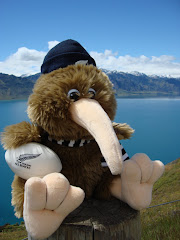
Monday, December 29, 2008

T.S.S. Earnslaw & Walter Peak Station


One of the other really nice things about Queenstown is the T.S.S. Earnslaw, an old steamship built in 1912, the same year as Titanic. Every day she plies the waters of Wakatipu between Queenstown and remote Walter Peak Station carrying supplies and tourists.

The Earnslaw is immaculate, lovingly maintained by its owners Real Journeys. Part of the main deck is opened so that passengers can look down into the engine room which is also very tidy. This old ship burns through one tonne of coal per hour and cruises at about 12 knots. She may not be the fastest afloat on the lake, but she surely is the most elegant.

There are several trips per day that dovetail with farm tours, horse trekking, and meals at Walter Peak. On the farm tours you're invited to feed the animals which include sheep, deer, and highland cattle. The farm tour incorporates demonstrations of sheepdog mustering and also sheep shearing.


The horse treks take about an hour to complete, following a circuit to a scenic spot for a photo opportunity. Kirwin's little feet couldn't quite reach the stirrups so Zonk went on her own. Here she is, kitted with a genuine Driza-Bone to keep the wind off.

Imagine sitting in Walter Peak's patio restaurant, looking back toward Queenstown. You sip on buttery chardonnay, your belly pleasantly full of fresh local fare, and let the sun gently warm your face. The clear blue waters of Wakatipu lap at the shore, lulling you into a tranquil bliss. La dolce vita at its best.


Kirwin and Zonk were here on 18-Dec-2008.

Sunday, December 28, 2008

Glenorchy

The 45 km road from Queenstown to Glenorchy takes about one hour to drive and is sealed the whole way. It is eye candy in terms of the magnificent scenery and there are several parking bays at the side of the road where it is safe to stop and take photos. Glenorchy itself lies to the left of the triangular mountain in the centre of this image.

Here Kirwin is taking a load off in front of an old boat shed. Its just a stone's throw from the relaxed Glenorchy Café and its outdoor picnic tables.


A few doors up from the café is Dart River Jet Safaris, owned and operated by Ngai Tahu. Their Wilderness Safari is really worth doing. The 4WD component drives through an area known as Paradise (a.k.a. Arcadia) and Lord of the Rings fans will find themselves in territory that seems strangely familiar. Fangorn Forest, anyone? The 4WD excursion ends where river flooding has washed away the track. From there its a short walk through mossy 1000+ year old protected forests to the river, where your jetboat will speed you up the Dart River as far as possible and practical before whisking you back to the jetty at Glenorchy.

Take your camera with you, but also be pleasantly surprised by the photograph pack that's waiting for you on your return. Rain ponchos are provided but you will do the odd 360 on the water, and you will get wet.

Kirwin thought he was too sexy for his poncho and decided to take the jet boat for a spin after everyone disembarked.

Glenorchy is also the last stop before starting the Routeburn Track, one of New Zealand's Great Walks through southwestern Fjordland, a preserved World Heritage Area.

Kirwin was here on 19-Dec-2008.

Queenstown


This is Queenstown from the Skyline restaurant on Bob's Peak, as seen on the evening of 17-Dec-2008. It looks as though the photo was taken with a fisheye lens but actually it has been stitched together from three of Zonk's photos using Hugin.

Thousands of years ago Lake Wakatipu was carved out by glaciers into its 80 kilometer S-shape of today, the middle of the S being Queenstown and the ends being Kingston to the south and Glenorchy to the north. At its deepest point the lake bottom lies 440 meters below the surface, making it almost as deep as the peaks around it are high.

Wakatipu is said to be the shortened version of Wakatipuwaimaori, which roughly translated means fresh water trough goblin because of the lake monster that is supposed to dwell in its depths, guarding valuable sources of pounamu (greenstone or nephrite jade) in nearby river valleys. By coincidence, Lake Wakatipu has been used in the past by film-makers as a stunt double for Scotland's Loch Ness (e.g. Sony Pictures' 2007 production of The Water Horse).

Queenstown was originally a gold mining town, but when the gold rush was over nearly two thirds of the local population left almost overnight. Tourism filled the gap and now Queenstown is considered the Adventure Capital of New Zealand, possibly the world. The mountain ranges in the upper left of the photo are The Remarkables and this is where Zonk learned to ski in 1988. The other skifield close to Queenstown (behind the camera) is Coronet Peak.

Although the scenery is lovely, Kirwin says he doesn't want to go back to Queenstown again. It is a bit too touristy, over-developed, over-priced and fast-paced for his tastes.

Having said that, one of the redeeming features of Queenstown is its best kept secret, the Bathhouse Restaurant located at the extreme lefthand side of the beach (opposite side to the Earnslaw's berth). Kirwin had three courses and a glass of wine for NZ$100 (approx. US$55) and he says it was the nicest meal he's had in years. The bathouse itself is a historic fixture. There's a book of its history in the restaurant so if you decide to have a meal there, make sure you ask to see it. The old newspaper articles make for an amusing read. Even in the 1900s residents complained about extortionate builder's fees!

Kawarau Gorge

Here's young Kirwin parked in front of the Kawarau River as it flows through the gorge of the same name. Kawarau Gorge was a popular spot for gold miners in the mid-1800s. At the Cromwell end of the gorge is a very interesting tourist stop at Goldfields Mining Centre. You can walk amongst old gold miner's camps and see some of the original equipment still in working order. Kirwin had a go pointing the gravity fed water cannon at a bank of dirt. I think he liked the sense of power it gave him because it was tough work to wrench it away from him.

In the end he agreed to try digging the earth the old fashioned way. His little wings struggled a bit with the shovel and the low gold yield was probably a direct result of this. Kirwin was a tad frustrated at this point and started suggesting his gold pan would make a better jacuzzi.


At the Queenstown end of Kawarau Gorge you'll find the world famous A.J. Hackett's Bungy operation. The Kawarau Bridge site was also the first commercial bungy jumping site in the world, and the place where Zonk took her first leap of faith back in 1989.

Adjacent to the bridge is a winery owned by Hackett's business partner, Henry van Asch, aptly named Freefall Wines. On 20-Dec-2008, we stopped into the cellar as part of a guided wine trail. This is where Kirwin was romanced by his two Singapore Girls.


The winery also has a nice restaurant attached, styled in retro 1960s New Zealand decor. Here's a picture of Kirwin waiting patiently to be seated for lunch next to a vase of Mount Cook lilies, a native of NZ that grows well in this part of the South Island.


We also stopped at several other vinyards between Kawarau Gorge and Cromwell and learned that the entire region is declaring itself organic. This is not something that's normally easy to do so being somewhat isolated will work to their advantage. Kirwin would have loved a nice glass of red but he was designated driver for the day. Apart from that one slip up with his Singapore Girls, Kirwin was a good wee Kiwi and he stuck to the Coca-cola instead.

By the time we hit Peregrine Wines, Zonk was starting to sag at the knees. Here's a picture of Kirwin helping to keep her upright amongst barrels there.

Cromwell

This is Kirwin sitting at what used to be known as The Junction, a point where the Clutha and Kawarau rivers once met - very handy for the local gold miners back in the 1860s. During the 1970s the area was flooded to form Lake Dunstan as part of establishing a source of hydroelectric power for New Zealand. Some of the old town submerged when the lake formed. As part of the project the new town of Cromwell was planned and established on adjacent higher ground.

A few of the old buildings remain on the edge of Cromwell and several have been renovated into a quaint tourist village sporting trendy art galleries, museum, cafés and the like. One of the old villas houses a store named Provisions which sells delicious preserves and bakery items.

Warning: entering Provisions on a Saturday afternoon is hazardous to your waistline. This is when the kitchen prepares items for Sunday morning's outdoor Farmer's Market. When Kirwin paid a visit on 20-Dec-2008 they were baking gingerbread and the whole shop smelled divine.


Cromwell is also known as the Fruit Bowl of Central Otago and is the perfect place to stock up on groceries before hitting the more expensive tourist places such as Queenstown.

Lindis Pass & Taras

The McKenzie Basin and Central Otago are separated by Lindis Pass. Here's a view from the top of the pass, looking north, back toward McKenzie country. In the winter this area is typically covered with snow and occasionally the pass has to be closed. You can see how dry it gets in summer.

Not far from the southern side of Lindis Pass is Taras. It is tiny, boasting only a petrol station, café and wool shop. Taras was briefly famous for being the home of a wiley old sheep nicknamed Shrek. The café in Taras is cozy, giving travellers the perfect place to stop for a break. This is the view you'll get if you sit out front in the summertime. Kirwin chowed down on pancakes with bacon, bananas and maple syrup, while I sipped away on a latte.

Next to the café is a shop full of wool and woollen clothing. It's a great place to pick up last minute woollies if you're on the way to the skifields around Queenstown and Wanaka. Merino is the specialty of nearby Bendigo Station. This type of wool is very fine and in great demand with suit makers. There's also a blend of wool and possum fur (often branded as Merino Mink) which is soft, plush, and a bit more expensive than plain wool.

Kirwin first traversed the Lindis Pass and stopped in Taras for brunch on 17-Dec-2008.

Lake Tekapo


Kirwin and I cleverly managed to drive while it was raining and stop at our next destination just before the rain caught up with us. Once again we look north at some stormy weather, but here in Tekapo township it is warm and dry. The english translation for Tekapo is roughly night sleeping mat which is perfect for this little township because it is a great stopping point if you are travelling between Christchurch and Mt Cook or Queenstown, which is exactly what most tourists want to do.

Lake Tekapo has spectacular waters the colour of aquamarine due to the glacial silt that stays suspended in them. It lies in the heart of the McKenzie Basin, which has the odd quirk of being quite dry even though it is surrounded by mountains. Those same westerly winds we mentioned in relation to Cook Strait also come crashing into the Southern Alps, elevate and condense causing a lot of rainfall on the West Coast and snow on the Southern Alps. By the time they are over McKenzie country, they've little left to give, making the basin quite arid. However the glacial fed lakes in the region (like Tekapo) provide plenty of water to drive hydro-electric power stations and the canal system between the lakes creates a perfect environment for growing salmon.

Tekapo is located beside Mt John which in 2009 will become the first ever World Heritage Starlight Reserve. The Mount John Observatory is a joint venture between three NZ universities and one in Japan. Kirwin had wanted to spend a couple of hours stargazing there on the night of 16-Dec-2008 but cloudy weather put a stop to that part of his adventure. You can just make out the white dome of the observatory atop Mt John in this picture.

Sheep farming was the first industry to open up the McKenzie region and Tekapo has two well-known sites to honour that past: the Church of the Good Shepherd, and a bronze statue recognising the contribution of the good old sheepdog. Behind the stone chapel's altar are windows with jaw-dropping views of the lake and mountains beyond. Who needs stained glass when you have a place as beautiful as Tekapo right out the window? Kirwin reckons the windows are there to help take your mind off boring sermons.

The pretty pink and purple flowers are lupins. They're the scourge of a farmer's life because stock will not eat them. Early British settlers brought seeds to NZ so they could grow things to remind themselves of home. Unfortunately the environment in the McKenzie Basin and Otago (further south) provides the perfect conditions for lupins to grow like weeds along the roadsides. Kirwin says it gives him hayfever.